Bias Reduction
99.9%
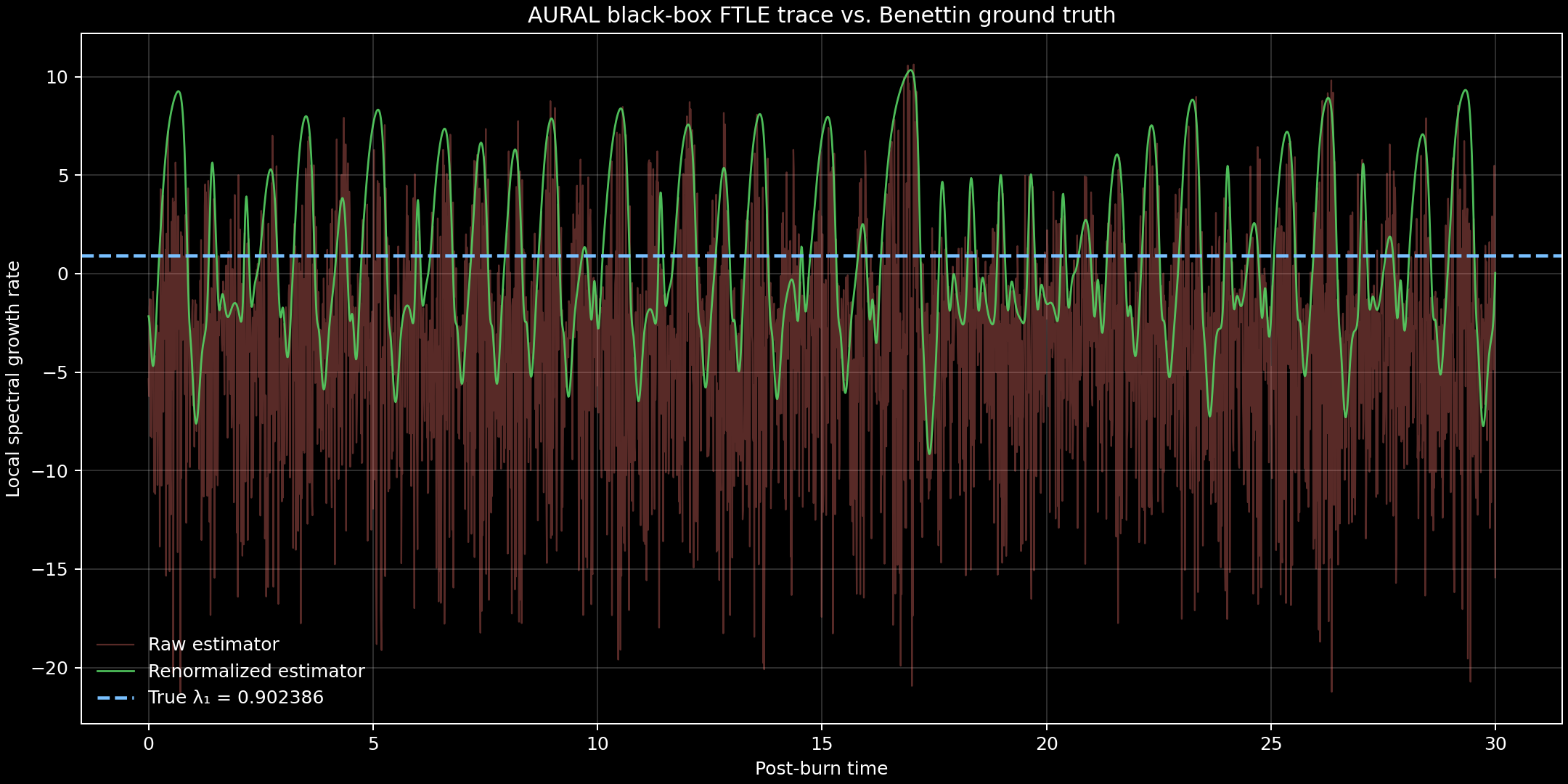
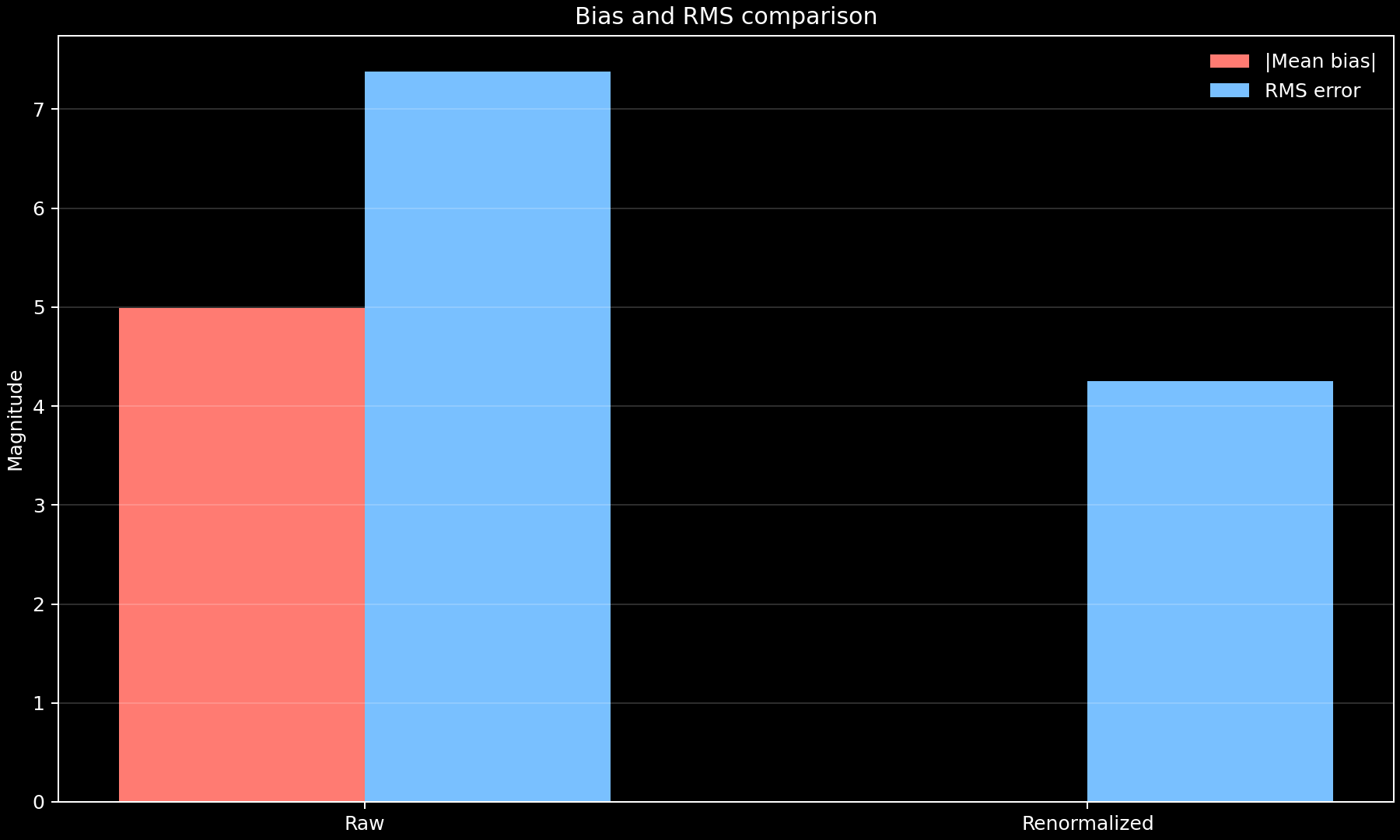
Mean bias collapse from naive random-direction sampling to persistent renormalized tracking.
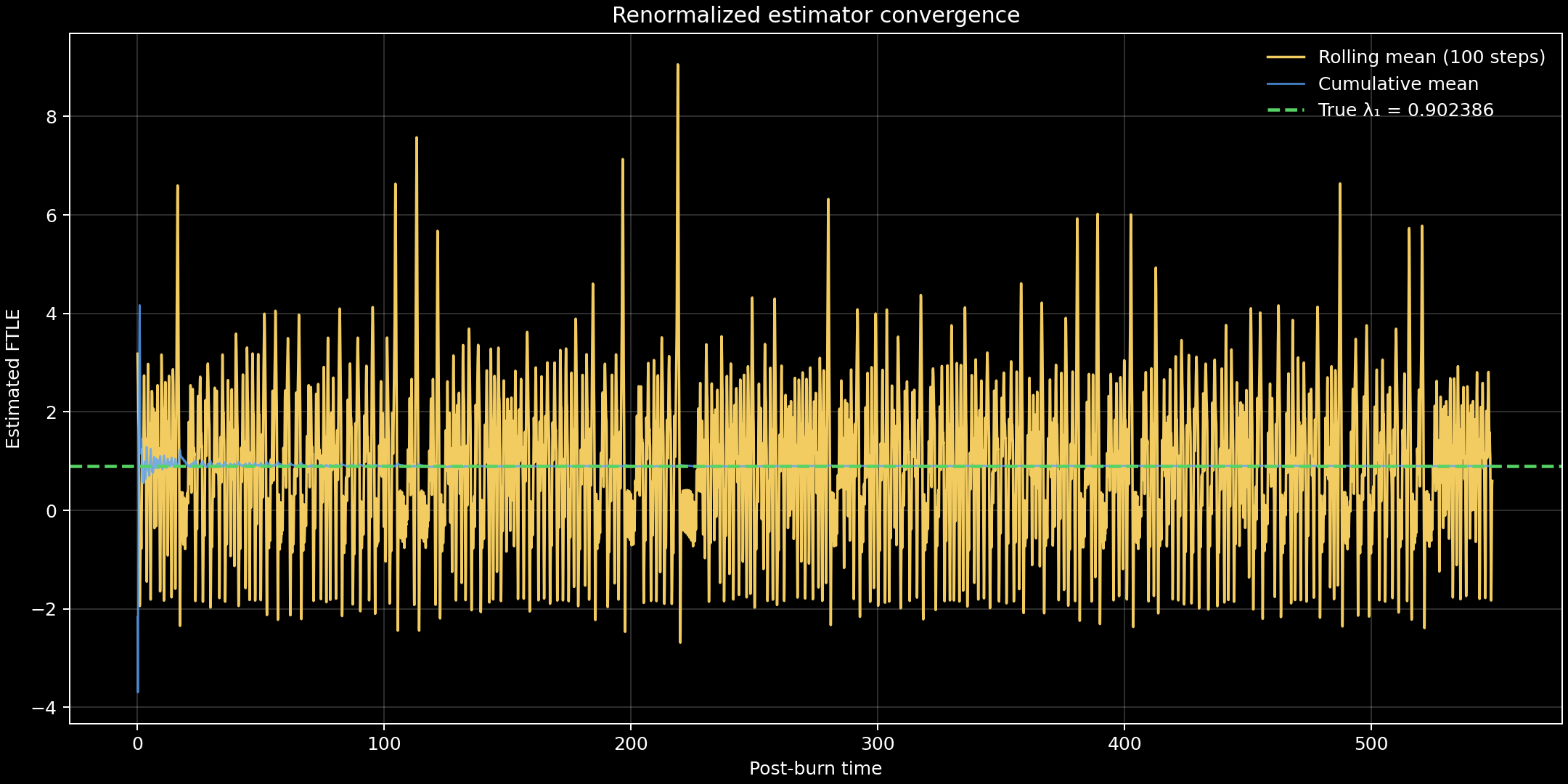
Spectral growth rate γ(x) is estimable from trajectory observations alone. This simulated Lorenz benchmark shows persistent renormalization collapsing directional bias, recovering the dominant local instability rate, and supporting a black-box-compatible governance claim.
Static dashboard backed by reproducible simulation output.
Spectral growth rate γ(x) is measurable from trajectory observations alone.
Renormalization suppresses contracting-direction bias and keeps the perturbation vector calibrated.
The measured rate is accurate enough to support adaptive, energy-bounded governance logic.
Loaded from AURAL_FTLE_results.json when available, with licensing-safe fallbacks.
| Metric | True (Benettin) | Raw Estimator | Renormalized Estimator |
|---|---|---|---|
| Largest Lyapunov λ₁ | 0.903099 | — | — |
| Mean Estimate | — | −4.075180 | 0.902442 |
| Mean Bias | — | −5.255000 | −0.000657 |
| RMS Error | — | 7.337471 | 4.249555 |
The licensing narrative depends on the full chain, not a single statistic.
Renormalization keeps ‖δ‖ = ε, so the estimator remains inside the local linear regime.
Linear-regime tracking suppresses curvature contamination and converges toward the dominant growth direction.
Accurate γ̂ is suitable for downstream adaptive law inputs and energy-bounded governance control.
All measurements arise from outputs only, establishing black-box compatibility for licensing.
Prospective licensees need evidence that governance does not depend on privileged model access.
Black-box AI systems are the hardest governance target because the controller cannot inspect weights, architecture, or internal state. AURAL demonstrates a viable trajectory-only path.
The raw estimator fails for the predicted reason: random perturbation directions are dominated by the strongly contracting exponent. Persistent renormalization fixes the failure mode structurally.
This is the difference between a white-box laboratory result and a licensing-ready external governance claim suitable for partner diligence.
Reproducible, fixed-seed Lorenz benchmark.
Lorenz attractor with σ = 10, ρ = 28, β = 8/3.
RK4 integration for nominal, perturbed, and tangent trajectories.
Raw finite-difference vs. persistent renormalized black-box FTLE estimator.
JSON-backed metrics and publication-ready figures generated by the Python simulation.
These images are produced by the simulation script and embedded directly in this deployable static page.